By Kate Sullivan
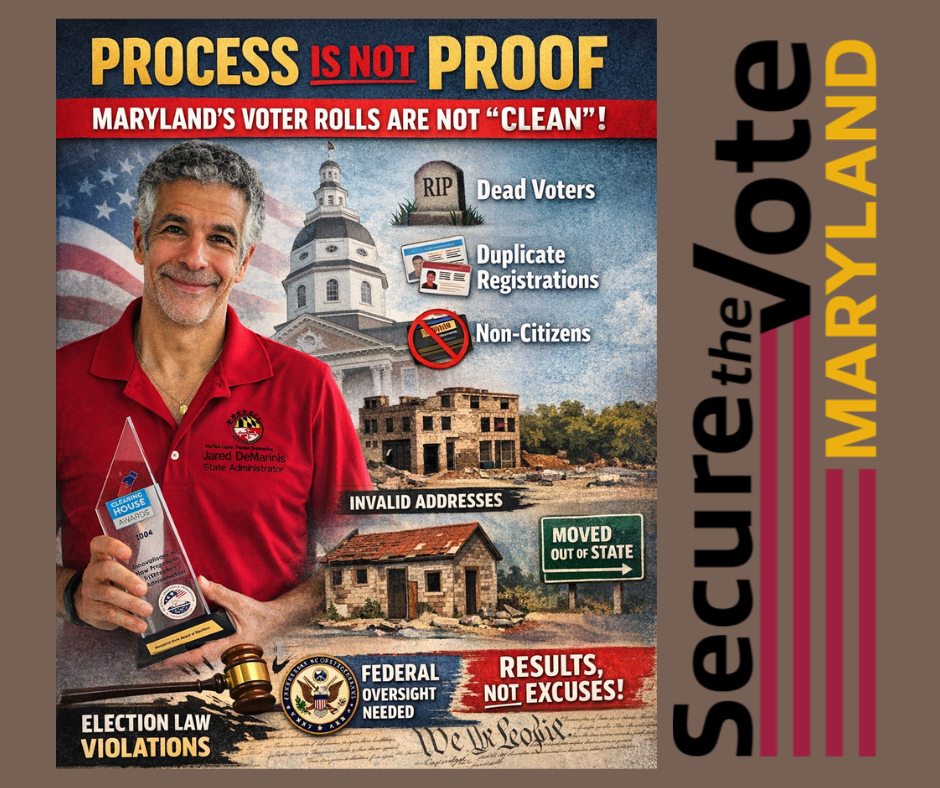
Maryland State Board of Elections Administrator Director DeMarinis continues to claim that the process his office follows proves Maryland’s voter rolls are “clean.” The facts say otherwise.
A process is only as credible as its outcomes — and Maryland’s outcomes show systemic noncompliance with election law, chronic voter-roll inflation, and thousands of ineligible voters listed as “active” for years.
The Facts (Repeated, Verified, Ignored)
We have submitted over 236,000 verified voter registration violations, including:
- deceased voters,
- duplicate registrations,
- non-citizens, (see The Curious Case of Ian Roberts)
- ineligible addresses (P.O. boxes, vacant lots, abandoned buildings),
- and voters who moved out of jurisdiction or out of state.
These are not estimates or guesses. They are easily verifiable records, repeatedly reported to election officials.
Clear Violations of Maryland Law
Across all 24 local jurisdictions, we identified deceased and duplicate voters who have remained “active” for 4+ years — a direct violation of Maryland Election Law Title 3, Subtitle 5 (§§ 3-501–3-503).
The law requires timely removal. It does not allow indefinite delay or reliance on “process” instead of compliance.
Counties With More Voters Than Eligible Citizens
Maryland now claims a highly implausible 98% statewide registration rate — and 10 counties exceed 100% registration, including Calvert, Carroll, Charles, Harford, Howard, Montgomery, Prince George’s, Queen Anne’s, Talbot, and Worcester.
That means more registered voters than eligible citizens. That is not a rounding error — it is a structural failure.
Federal Oversight Is Lawful — and Required
Director DeMarinis also claims sharing voter rolls with USCIS (U.S. Citizenship and Immigration Services) would violate state law. That claim is wrong.
- The Guaranty Clause requires the federal government to protect lawful republican elections.
- The Supremacy Clause prevents states from blocking legitimate federal enforcement.
- The Elections Clause confirms federal authority over voter systems used in federal elections.
Verifying voter eligibility is not “nonelectoral.” It is core election integrity.
Bottom Line
Director DeMarinis’s claims fail on both factual and constitutional grounds.
Worse, his refusal to comply with lawful federal requests has triggered yet another avoidable lawsuit, costing Maryland taxpayers over $75,000 to defend ideology dressed up as legal principle.
Maryland may administer elections — but it may not ignore its own laws, obstruct federal oversight, or force taxpayers to bankroll political resistance.
Process is not proof. Results matter. Accountability is required.